Unseen
Vision.
On-device AI for Spatial Perception.
Word First AI pendant built with and for
the blind and low-vision community.
On-device AI for Spatial Perception.
Word First AI pendant built with and for
the blind and low-vision community.
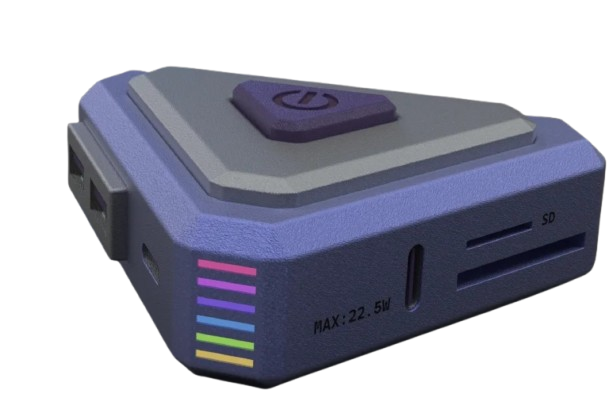
Camera, LiDAR, on-device AI, speaker — worn at the chest. Spatial intelligence without a screen. Designed from the ground up for the blind and low-vision community: runs entirely on-device with no cloud dependency, integrates 10+ AI agents through the A2A protocol, and delivers environmental understanding in real time, at the weight of a keychain.
Crosswalk referenced traffic light detection: the core perceptual task.
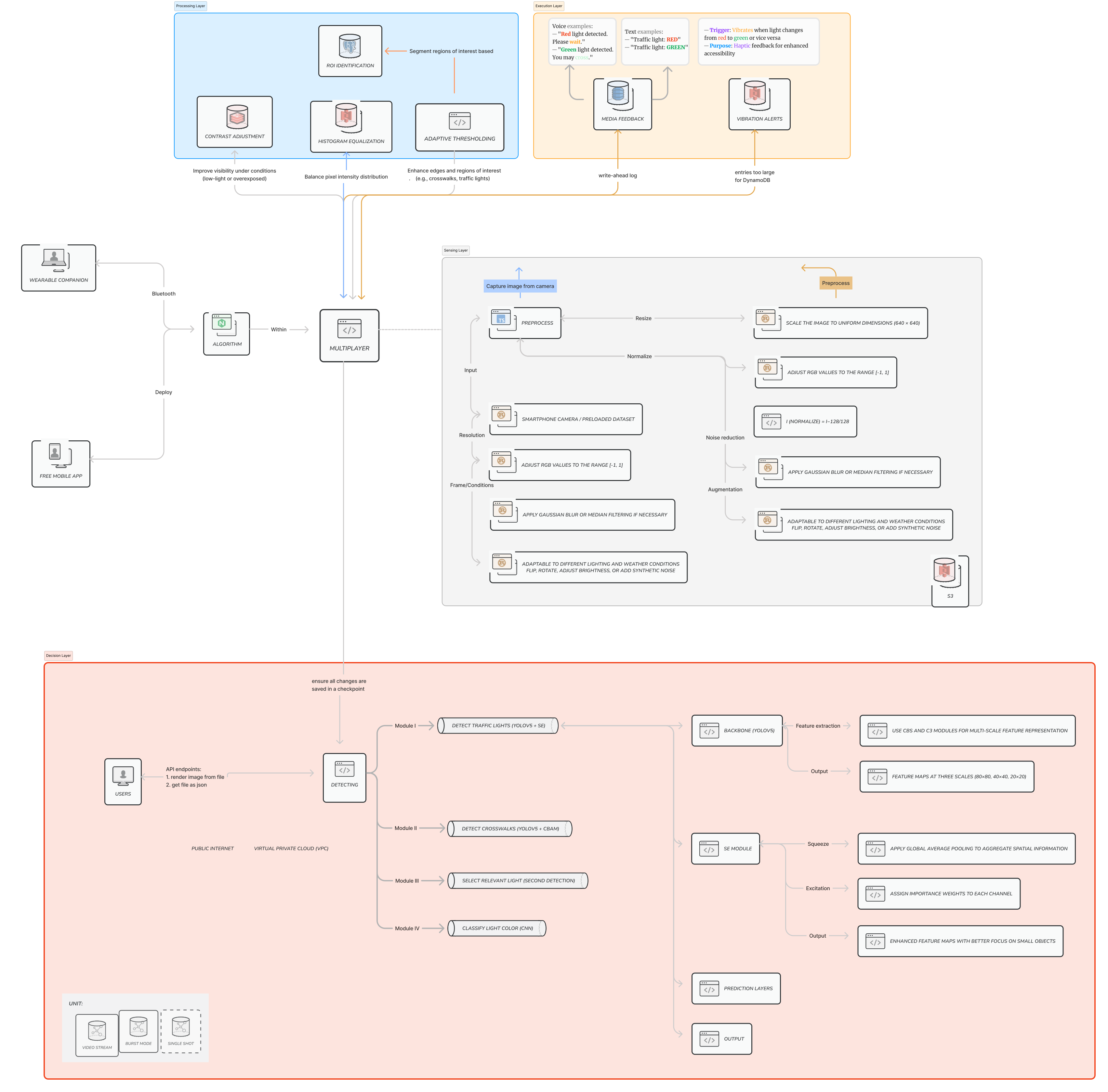
Rather than identifying signals in isolation, Lightnet 7B uses crosswalks as spatial anchors to resolve the correct pedestrian signal in complex multi light intersections, where signals overlap, stack, or face conflicting directions across multiple lanes.
Built on a YOLOv5 backbone with SE and CBAM dual attention mechanisms. Trained on 12,000+ annotated intersection frames spanning day, dusk, rain, and high contrast conditions. The only model purpose-built for pedestrian signal detection at this granularity.
Lightnet 7B Model Architecture
10+ specialized micro models run simultaneously, each an expert in one perceptual task:
Braille recognition · Realtime text OCR · Scene understanding
Pedestrian navigation · Depth estimation · Object tracking
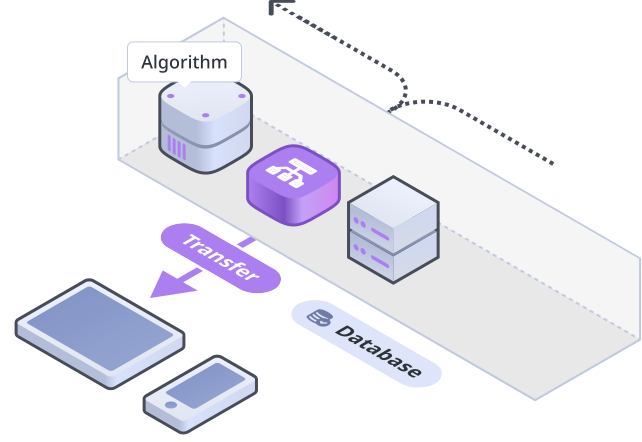
Each agent is orchestrated by an Agent-to-Agent protocol that routes context across models, resolves conflicts when outputs disagree, and synthesizes a unified spatial response in under 120ms. Backed by multimodal foundation models with video and image language understanding.
Not a single model doing everything. A coordinated intelligence where each agent is an expert.
A2A Protocol Agent-to-Agent Network
Three output channels. Zero learning curve.
Vision enhancement through optical passthrough. Auditory guidance via bone conduction speaker, ambient without isolating. Haptic feedback for directional urgency and confirmation.
Intelligence is stored as callable agents, activated by voice on demand. No screens, no menus, no app to launch. The interface disappears until the moment it's needed.
iGUI Trimodal Context Architecture
eyeOS is the only device in its class purpose-built for spatial navigation by the visually impaired.
Three dimensions where purpose-built design produces quantifiable difference: detection precision, processing architecture, and agent coordination.
Below: a technical comparison against the nearest wearable AI peers.
| eyeOS Pendant | Meta Ray Ban | Omi AI | Rokid Max | |
|---|---|---|---|---|
| Primary function | Spatial nav for VI | Social capture + voice AI | Conversation capture | AR display streaming |
| Detection (mAP@0.5) | 97.2% Lightnet 7B | ~23% est. | N/A, no camera | ~31% est. |
| On device inference | 100% local | Cloud first (~18% local) | Cloud only | Partial (~28% local) |
| Inference latency | <120ms per frame | ~800ms (cloud RTT) | ~1.2s (cloud RTT) | ~400ms (partial) |
| Multi agent coordination | 10+ specialized models | 1 (Meta AI) | 1 (conversation) | 2 (limited) |
| Visual input | Camera + LiDAR | Camera only | No camera | Camera only |
| Haptic feedback | Yes | — | — | — |
| Open source | Yes | — | — | — |
| Community field testing | 18 months, 80+ devices | — | — | — |
True accessibility means no one left in the dark.
Each unit hand-delivered to blind and low-vision participants at Nanjing School for the Blind.
Not lab tests. Real navigation, real conditions, real feedback loops that shaped every hardware iteration from first prototype to final form.
Full co-design with the community from first prototype to architecture lock.
Bimonthly onsite visits. Every feature earned its place at the intersection, not in a meeting room.
On device Lightnet 7B response per frame for pedestrian signal detection with no cloud round trip required.
Fully functional in dead zones, tunnels, and low connectivity environments where cloud dependent devices fail entirely.
Precision recall benchmark on crosswalk referenced traffic light detection in dense urban intersections.
Validated across day, dusk, rain, and adverse contrast, the standard metric for object detection performance at deployment scale.
Sincerely elevate the species.
We respect your Privacy.
Over 250 million people live with moderate or severe visual impairment. 36 million are blind. They navigate a world built without them in mind.
Access to spatial awareness is not a product feature. It is a fundamental condition for autonomy.
Every feature was validated with real users before it shipped. 80+ prototypes delivered to Nanjing School for the Blind.
Bimonthly on-site visits. Direct feedback loops from people who rely on the system daily. Not UX panels, not simulations. 18 months of iterating at human speed.
Built on open source. Given back to open source.
Detection algorithms, annotated datasets, training pipelines, released as community resources, not competitive moats. The mission scales when the infrastructure is shared.
AI is rewriting the grammar of hardware interaction. More intelligent models are leaving the cloud, entering the body of the machine. The question is no longer whether machines can see. The question is: who gets to benefit when they do.
Bottom-up waves don't await top-down benchmarks.
We chose the hardest entry point. We build spatial intelligence for those the world forgot to design for.
Tech advances through a prime life-force beyond man's body—romantic, wild, inevitable.
We've tasted creation's heat. That obligates us to participate—to build, to steward, and to help shape the world we owe.
Nanjing, Zhujiang Road. A blind man navigating a broken sidewalk. Why can cars read traffic lights, but a person cannot safely cross the street?
Nanjing School for the Blind. First hardware prototypes. Algorithm development begins. The crosswalk referenced spatial anchor methodology, the insight that would become Lightnet 7B, developed, tested, and validated in the field.
MVP deployed as app + wearable combination. WAIC exhibition, Shanghai. CPPCC recognition. 80+ devices field-tested with the community over 18 months of co-creation.
Full hardware integration: pendant form factor, A2A multi-agent architecture, Lightnet 7B on device inference, iGUI trimodal output. Vision Computing. Rokid Acquired
Detection models, datasets, and infrastructure released to the community. The platform expands beyond the pendant.
Young, scrappy, and hungry.
We are Real Time Engagement.
For we live by faith, not by sight.
2 Corinthians 5:7
2025
The mission continues at scale.
Perception is a right, not a privilege.
Build with Research and Empathy